Which Certification Should You Trust Most?
There is no single certification that is universally 'best' — USDA Organic, NATRUE, and ECOCERT/COSMOS each verify a different layer of a product's organic and natural integrity, and the most rigorous brands typically combine more than one to cover the full spectrum from farm to finished formula.
USDA Organic's particular strength is its supply-chain depth: because every entity from the farm to the final manufacturer must be independently certified, it offers the most thorough verification of where and how raw agricultural ingredients were actually grown. Its limitation is that it focuses primarily on agricultural sourcing rather than auditing every detail of the finished formulation's full ingredient list.
NATRUE's particular strength is formulation-level scrutiny: its tiered system and strict water-accounting rule make it especially rigorous at restricting synthetic substances in the finished product, regardless of where individual raw ingredients originated. Its limitation, from a US consumer perspective, is lower brand-name recognition compared to the widely familiar USDA Organic seal.
ECOCERT/COSMOS's particular strength is its broad environmental and sourcing scope, extending certification criteria beyond ingredient sourcing into specific prohibited-substance lists and packaging requirements. Its limitation is that, like NATRUE, it remains somewhat less recognized by name among general US consumers compared to USDA Organic, despite its substantial global market presence.
For consumers seeking the highest level of combined assurance, a product holding both an agricultural-origin certification (USDA Organic) and a formulation-level certification (NATRUE or COSMOS Organic) offers verification across both dimensions — agricultural sourcing and finished-product formulation — rather than relying on a single certifying lens.
Brands that pursue dual or triple certification across USDA Organic, NATRUE, and/or COSMOS typically undergo separate, independent annual audits for each standard, since the certifying bodies operate independently of one another with their own distinct criteria, documentation requirements, and renewal processes.
What Are the Warning Signs of an Uncertified 'Organic' Claim?
The clearest warning sign of an uncertified organic claim is the absence of a recognized third-party certification logo on the packaging, regardless of how prominently the words 'organic,' 'natural,' or 'clean' appear on the front label.
● No certification logo: if the product claims to be 'organic' but displays no USDA Organic, NATRUE, COSMOS, or ECOCERT seal, the claim is self-declared and unverified
● Vague marketing language: terms such as 'clean,' 'green,' 'eco-friendly,' or 'naturally derived' carry no regulated definition in US cosmetics and require no independent audit
● Inconsistent ingredient marking: certified organic products typically mark each certified organic ingredient individually in the INCI list (often with an asterisk or footnote); the absence of this marking on a product claiming broad organic content is a red flag
● Certification claims without verification: a logo alone should be checked against the certifying body's public registry where available, since counterfeit or expired certification claims do occur in the broader market
Consumers can verify a specific brand's certification status directly through the certifying body's own documentation or public database, where available, rather than relying solely on the presence of a logo on packaging.
How Does Alteya Organics Meet These Certification Standards?
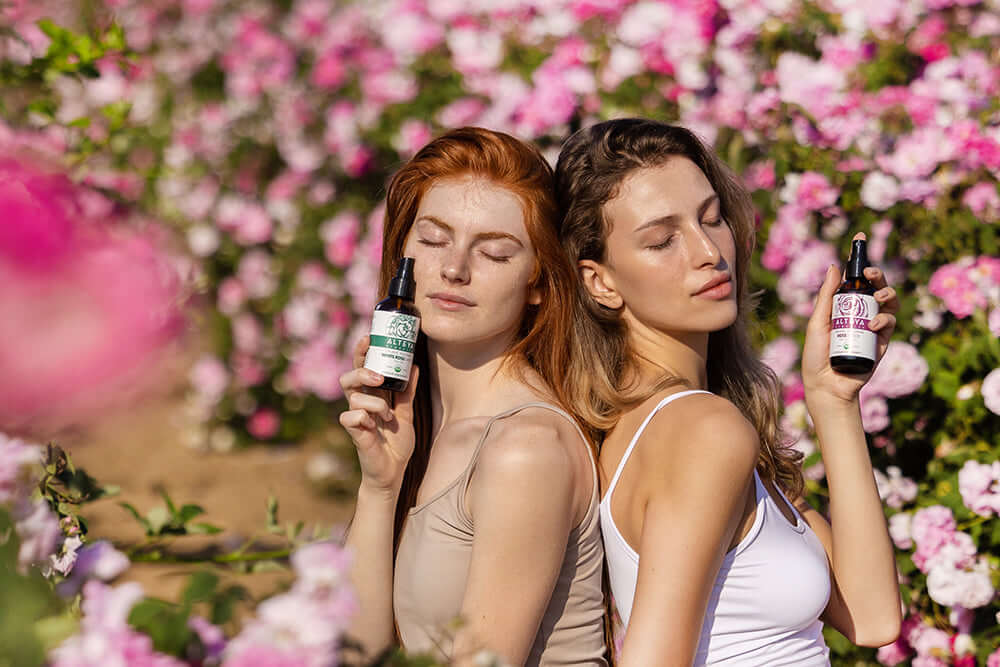
Alteya Organics holds dual certification under both USDA Organic and NATRUE, combining agricultural-origin verification with formulation-level natural and organic scrutiny across its Rosa Damascena-based skincare range.
On the USDA Organic side, Alteya Organics cultivates its own Rosa Damascena on certified organic fields within the Bulgarian Rose Valley, meaning the agricultural origin of its core ingredient is independently verified from the farm itself — not merely at the point of final manufacturing. This vertically integrated, field-to-bottle model directly supports the full supply-chain verification USDA Organic certification requires.
On the NATRUE side, Alteya Organics formulates its rose water and rose oil through steam distillation rather than solvent extraction, avoiding the synthetic processing methods NATRUE's formulation-level standard restricts. Because the brand's primary liquid base across many of its products is plant-derived rose water rather than conventional water, its formulations are also well-positioned relative to NATRUE's stricter water-accounting rule, which only counts plant-derived water toward a product's natural ingredient percentage.
This dual-certification approach reflects the broader principle outlined throughout this article: no single certification covers every dimension of organic and natural integrity, and combining an agricultural-origin certification with a formulation-level certification provides more comprehensive verification than either alone.












Leave a comment
This site is protected by hCaptcha and the hCaptcha Privacy Policy and Terms of Service apply.