Stage 1: How Is Rosa Damascena Cultivated for Rose Oil?
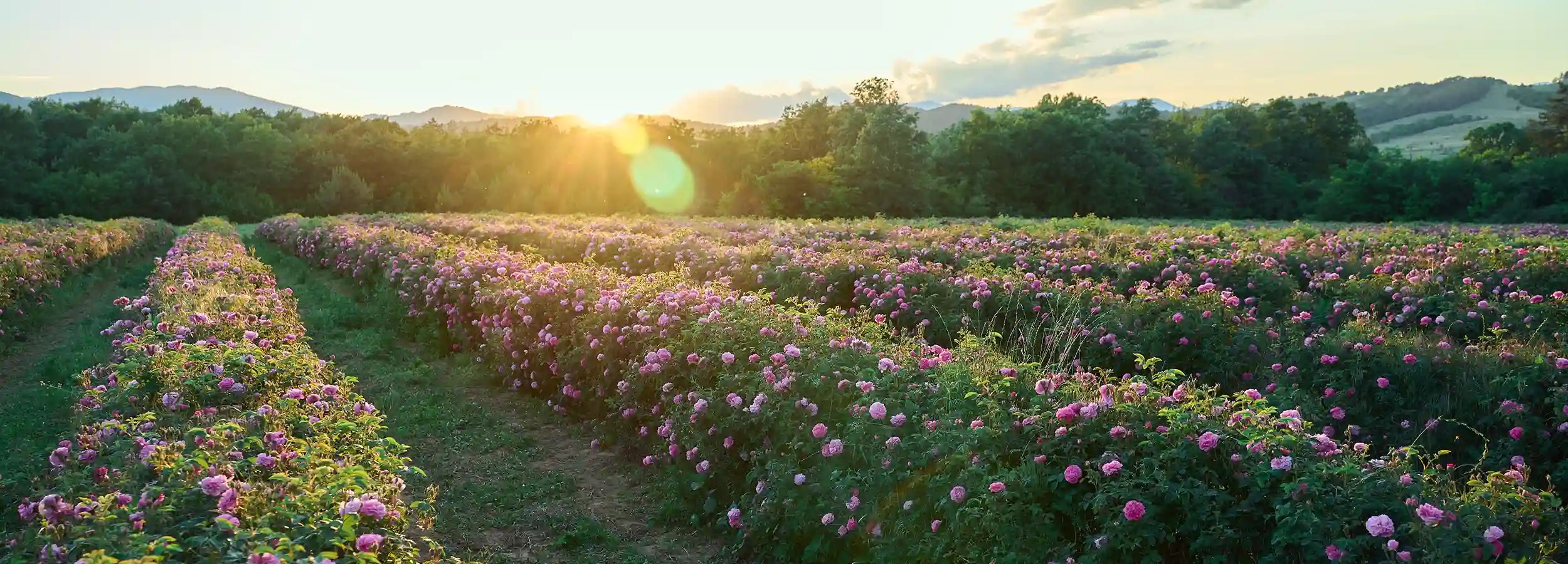
Rosa Damascena destined for rose oil production is cultivated as a perennial shrub, planted in rows across dedicated fields and maintained over many years, since the bushes generally do not reach optimal flowering productivity until their third year and can remain productive for a decade or longer before yield begins to decline.
In the Bulgarian Rose Valley, fields are typically situated on gently sloping terrain that allows for adequate drainage while remaining within the valley's protective microclimate, shielded from extreme weather by the surrounding Balkan and Sredna Gora mountain ranges. The fertile soil along the Tundzha River valley, combined with the region's specific combination of rainfall, temperature, and air quality, is widely credited with producing Rosa Damascena of unusually high aromatic complexity.
Certified organic cultivation — the standard Alteya Organics follows across its own fields — requires that no synthetic pesticides, herbicides, or chemical fertilizers are used at any stage of growing the rose bushes, with soil health maintained instead through organic farming practices verified by third-party certification bodies such as the USDA National Organic Program.
Rosa Damascena fields typically reach their full flowering potential in the third year after planting and can remain productive for approximately ten years before yields begin to decline, after which fields are typically replanted to maintain consistent production.
Stage 2: How Are Rose Petals Harvested?
Rose petals for oil production are harvested entirely by hand, picked individually at dawn during a brief seasonal window, because both the timing of the season and the timing of each day directly affect the concentration of aromatic compounds captured during distillation.
Seasonal Timing
The harvest season in the Bulgarian Rose Valley lasts only about 22 to 25 days in total, typically occurring from mid-May through mid-June. This narrow window represents the period when Rosa Damascena blooms reach peak essential oil content — harvesting before or after this period yields significantly lower aromatic concentration.
Daily Timing
Each day's harvest begins at first light and concludes before late morning, since rising daytime temperatures cause the petals' volatile aromatic compounds to begin evaporating and degrading rapidly once the sun is fully up. Harvesting dew-covered petals in the cool early morning hours is considered essential to preserving maximum oil content and quality.
The Picking Method
Each flower is cut individually by hand rather than mechanically harvested, since mechanical methods risk bruising the delicate petals — bruising accelerates oxidation and causes premature loss of aromatic compounds before distillation can occur. Pickers place the cut flowers gently into woven baskets, traditionally made of willow, to minimize compression and damage during collection.
An experienced rose picker can typically harvest several kilograms of rose petals per hour by hand during the peak bloom window, though exact yields vary based on bloom density, weather conditions, and individual picker experience.
Stage 3: Why Must Rose Petals Be Distilled So Quickly After Harvest?
Rose petals must be transported to the distillery and processed within hours of harvest because the volatile aromatic compounds responsible for rose oil's quality begin to diminish almost immediately after picking, particularly under warm or sunlit conditions.
This time sensitivity is the primary reason rose distilleries in the Bulgarian Rose Valley are traditionally located directly within or immediately adjacent to the fields where the roses are grown — a model that minimizes the time between harvest and distillation to a matter of hours rather than the days that might be required if petals had to be shipped over longer distances.
Producers who do not control their own fields, or who purchase raw petals from third-party growers, face an inherent quality risk: any delay in transport or processing reduces the aromatic yield and complexity of the final rose oil. Alteya Organics addresses this by operating its own certified organic fields and distillation facilities together within the Rose Valley, allowing petals to move from the field to the still without the delays associated with sourcing from external growers.
Stage 4: How Does Steam Distillation Extract Rose Oil?
Steam distillation extracts rose oil by passing pressurized steam through fresh rose petals inside a sealed still, which releases the plant's volatile aromatic compounds as vapor; the vapor is then cooled and condensed back into liquid, naturally separating into an oil layer and a water layer.
Loading the Still
Fresh rose petals are loaded into a traditional copper still, known historically in Bulgaria as a kazan, along with water. Copper has been the preferred material for rose distillation for centuries due to its even heat conductivity and its chemical compatibility with the rose's aromatic compounds, which can react unfavorably with certain other metals.
Applying Steam and Heat
Steam is introduced into the sealed still, gradually heating the water and petal mixture. As the temperature rises, the heat causes the essential oil compounds stored within the petal's specialized oil-bearing structures to vaporize along with the steam. This process, technically known as hydrodistillation or steam distillation depending on the exact still configuration, typically continues for one to three hours depending on the specific equipment and batch size.
Condensation
The steam, now carrying the vaporized aromatic compounds, travels through a connected pipe into a cooling condenser. As the vapor cools, it returns to liquid form. Condenser temperature is carefully controlled — typically maintained between 35°C and 45°C — to prevent the natural waxes present in rose oil from solidifying and clogging the equipment.
Natural Separation















Leave a comment
This site is protected by hCaptcha and the hCaptcha Privacy Policy and Terms of Service apply.